Thursday, July 16, 2015

Apple Updates iPod Touch Amid Declining Sales

New iPod Touch design released by Apple, July 15, 2015.
New iPod Touch design released by Apple
Although the iPod's popularity has waned, Apple is updating its music player for the first time in nearly three years by giving the flagship Touch model a faster processor and better cameras.

The new iPod Touch also enables Apple Music, a $10-a-month service that offers unlimited playback of millions of songs. Apple Music launched June 30 as music fans increasingly embrace subscriptions over pay-per-song services such as Apple's industry-leading iTunes.

Original iPod


Although music players existed before the original iPod's debut in 2001, the iPod was the first to simplify syncing with digital music collections on personal computers. It was Apple's first success beyond personal computers and began a company transformation that led to the iPhone in 2007, the iPad in 2010 and the Apple Watch this year.

Many people now listen to music on smartphones rather than iPods, though. Sales of iPods peaked at nearly 55 million in fiscal 2008, the year after the iPhone came out. In the most recent fiscal year, which ended last September, Apple sold 14 million iPods. By contrast, Apple sold 169 million iPhones in the same period.

As demand has slowed, so has Apple's updates to the iPod: Apple no longer updates its iPods annually as it usually does with its top sellers.

But Wednesday's update shows Apple isn't giving up on the iPod.

The Touch is essentially an iPhone without cellular capabilities, as it runs the same iOS operating system and most of the same apps. It extends Apple Music and iPhone apps to teens and other younger customers who might not need cellphones or cannot afford cellular service.

Beyond music, the iPod Touch might get new customers hooked on Apple's apps, video and other content - such that they'll turn to an iPhone, iPad or Mac when they are ready.
Prices for the Touch start at $199, the same as an iPhone 6 with a two-year service contract, but the iPod Touch requires no monthly service fees for voice, text and data. Calling is possible through FaceTime videoconferencing over Wi-Fi.

Without a contract, an iPhone 6 starts at $649, compared with a few hundred dollars for some Android smartphones.

Roger Kay, president of the market research firm Endpoint Technology Associates, said the iPod Touch helps protect Apple from lower-priced competitors.

"Having a $200 small computer without cellular service is a pretty good price,'' Kay said. "This may be a second, third or fourth device for families that already have a bunch of Apple products. The nine-year-old wants something, so they get them a Touch.''

Rob Enderle of the Enderle Group said that while iPod sales have been declining, they are still massive.

 "Not everyone wants an iPhone, yet a lot of those folks loved their iPods,'' he said. "This product will be far more successful than anyone expects.''

Among the improvements:

The processor now matches that in the iPhone 6 and 6 Plus from last fall, rather than one from the iPhone 4s in 2011. Apple says the new chip is six times faster for general tasks and 10 times faster for graphics.

The rear camera can take sharper pictures, at 8 megapixels. That matches recent iPhones and exceeds the 5 megapixels in the previous Touch. The front and rear cameras can now take 10 shots per second and slow-motion video at 120 frames per second.

"Customers can experience next-level gameplay, take even more beautiful photos and enjoy their favorite music, TV shows and movies,'' said Greg Joswiak, Apple's vice president of iPhone, iPod and iOS product marketing.

Although the Touch has an accelerometer to track basic fitness, it doesn't have all of the iPhone's sensors. There's no barometer to measure steps climbed and no fingerprint ID to unlock the device. There's also no Apple Pay, the technology for making payments at retail stores. The screen remains at 4 inches, as measured diagonally, even though iPhones have gotten bigger at 4.7 and 5.5 inches.

Apple is introducing a new, $399 model with 128 gigabytes, matching the iPhone's maximum capacity. The base model has 16 gigabytes, enough for thousands of songs, though the iPod Touch is meant to hold photos, video and apps, too.

The $49 iPod Shuffle and the $149 Nano are getting the same colors, but what's inside isn't changing. Neither model can run Apple Music or the various iPhone apps.


Pluto up Close: Spacecraft Achieves Flyby, Then Calls Home

Members of the New Horizons science team react to seeing the spacecraft's last and sharpest image of Pluto before closest approach later in the day, at the Johns Hopkins University Applied Physics Laboratory (APL) in Laurel, Maryland, July 14, 2015.
Members of the New Horizons science team react to seeing the spacecraft's last and sharpest image of Pluto before closest approach later in the day, at the Johns Hopkins University Applied Physics Laboratory (APL) in Laurel, Maryland,
NASA's New Horizons spacecraft got humanity's first up-close look at Pluto on Tuesday, sending word of its triumph across 3 billion miles to scientists waiting breathlessly back home.
Confirmation of mission success came 13 hours after the actual flyby and, after a day of both jubilation and tension, allowed the New Horizons team to finally celebrate in full force.

"This is a tremendous moment in human history,'' John Grunsfeld, NASA's science mission chief, said at a news conference.

Principal scientist Alan Stern asked the entire New Horizons team in the audience to stand: "We did it! Take a bow!''

The unprecedented encounter was the last stop on NASA's grand tour of our solar-system's planets over the past half-century. The journey began 9 years ago, back when Pluto was still considered a full-fledged planet.

Tuesday morning, a cheering, flag-waving celebration swept over the mission operations center in Maryland at the time of closest approach. But until New Horizons phoned home Tuesday night, there was no guarantee the spacecraft had buzzed the small, icy, faraway — but no longer unknown — world.

New Horizons Scientist Hal Weaver, left, talks with Mark Holdridge, center, and Mike Buckley as they await information from from the New Horizons spacecraft as it passes Pluto, July 14, 2015, in Laurel, Md.

NASA said the spacecraft — the size of a baby grand piano — swept to within 7,700 miles of Pluto at 31,000 mph. It was programmed to then go past the dwarf planet and begin studying its far side.

To commemorate the moment of closest approach, scientists released the best picture yet of Pluto, taken on the eve of the flyby.

Pluto nearly fills the frame in this image from the Long Range Reconnaissance Imager (LORRI) aboard NASA’s New Horizons spacecraft, taken on July 13, 2015, when the spacecraft was 476,000 miles (768,000 kilometers) from the surface.
More to come
Even better images will start "raining'' down on Earth beginning Wednesday, promised principal scientist Alan Stern. But he had cautioned everyone to "stay tuned'' until New Horizons contacted home.

It takes 4 hours for signals to travel one-way between New Horizons and Earth. The message went out late in the afternoon during a brief break in the spacecraft's data-gathering frenzy. The New Horizons team kept up a confirmation countdown, noting via Twitter when the signal should have passed the halfway point, then Jupiter's orbit.
The uncertainty added to the drama. "This is true exploration,'' cautioned Stern, a Southwest Research Institute planetary scientist.
 
Among the possible dangers: cosmic debris that could destroy the mission. But with the chances of a problem considered extremely low, scientists and hundreds of others assembled at Johns Hopkins University's Applied Physics Laboratory erupted in jubilation when the moment of closest approach occurred at 7:49 a.m. EDT. The lab is the spacecraft's developer and manager.

The scene repeated itself a little before 9 p.m. EDT.

This time, the flight control room was packed compared with earlier, when it was empty because New Horizons was out of touch and operating on autopilot.

'A healthy spacecraft'
"We have a healthy spacecraft,'' announced mission operations director Alice Bowman. She was drowned out by cheers and applause; Stern ran over to give her a hug.

Later, Grunsfeld told reporters, "The spacecraft is full of images. We can't wait. We've opened up a new realm of the solar system.''

Added NASA Administrator Charles Bolden: "What a phenomenal day.''

Joining in the daylong hoopla were the two children of the American astronomer who discovered Pluto in 1930, Clyde Tombaugh. (Some of his ashes are aboard the spacecraft.)
Other celestial-minded VIPs included James Christy, discoverer of Pluto's big moon Charon, and Sylvia Kuiper des Tombe, daughter of Dutch-American Gerard Kuiper for whom the mysterious zone surrounding Pluto is named. Some Pluto Children — born Jan. 19, 2006, the very day New Horizons departed Earth — also were in the audience.

Congratulations pouring in
Throughout the day — coincidentally the 50th anniversary of the first close-up pictures of Mars from Mariner 4 — the White House and Congress offered congratulations, and physicist Stephen Hawking was among the scientists weighing in. President Barack Obama sent his best Tuesday night with a tweet: "Pluto just had its first visitor!''

 "Hey, people of the world! Are you paying attention?'' planetary scientist Carolyn Porco, part of the New Horizons' imaging team, said on Twitter. "We have reached Pluto. We are exploring the hinterlands of the solar system. Rejoice!''

The U.S. is now the only nation to visit every planet in the solar system. Pluto was No. 9 in the lineup when New Horizons left Cape Canaveral, Florida, but was demoted seven months later to dwarf status.

Scientists in charge of the $720 million mission hope the new observations will restore Pluto's honor.

Stern and other so-called plutophiles posed for the cameras giving nine-fingers-up "Pluto Salute.'' And in a nod to that other Pluto, a team member carried a yellow stuffed dog on her shoulder Tuesday night.

The picture of Pluto taken Monday showed a frozen, pockmarked world, peach-colored with a heart-shaped bright spot and darker areas around the equator. It drew oohs and aahs.

 "To see Pluto be revealed just before our eyes, it's just fantastic,'' said Bowman.

The Hubble Space Telescope had offered up the best pre-New Horizons pictures of Pluto, but they were essentially pixelated blobs of light.

Flight controllers held off on having New Horizons send back flyby photos until well after the maneuver was complete; they wanted the seven science instruments to take full advantage of the encounter. After turning toward Earth to send down a snippet of engineering data acknowledging everything was fine, the spacecraft was going to get right back to science work.

New Horizons is also expected to beam back photos of Pluto's big moon, Charon, and observe its four little moons. It will take until late 2016 for all the data to reach Earth.

New Horizons already has confirmed that Pluto is, indeed, the King of the Kuiper Belt. New measurements it made show that Pluto is 1,473 miles in diameter, or about 50 miles bigger than estimated.

That's still puny by solar-system standards. Pluto is just two-thirds the size of Earth's moon. But it is big enough to be the largest object in the Kuiper Belt, a zone rife with comets and tens of thousands of other small bodies.

Stern and his colleagues wasted no time pressing the U.S. Postal Service for a new stamp of Pluto.

The last one, issued in 1991, consisted of an artist's rendering of the faraway world and the words: "Pluto Not Yet Explored.'' The words "not yet'' were crossed out in a poster held high Tuesday for the cameras.

Microsoft to Launch Windows 10 on July 29

FILE - A laptop computer featuring Windows 10 is displayed at Microsoft Build in San Francisco, California, April 29, 2015.
FILE - A laptop computer featuring Windows 10 is displayed at Microsoft Build in San Francisco, California
Microsoft Corp., which will launch Windows 10 on July 29, promises greater speed, security and seamlessness in its new operating system. 
It’s "fast, more secure and compatible. It’s familiar and easy to use. It’s automatically up to date," Yusuf Mehdi, corporate vice president for Windows, said in a press release for the company based in Redmond, Washington.
The new operating system will be available temporarily as a free upgrade for devices using Widows 8/8.1 or 7, all earlier versions of the software.
The OS release rolls out with a yearlong campaign to "celebrate those who inspire and empower others" using technology. For the #UpgradeYourWorld campaign, Microsoft will partner with 10 global and 100 local nonprofits, investing $10 million in support of their missions.
The 10 global nonprofits include CARE, Code.org, Keep a Child Alive, Malala Fund, Pencils of Promise, Save the Children, Special Olympics, The Global Poverty Project and The Nature Conservancy.
The company’s stock price rose by 24 cents, to 44.85 a share, in Monday’s premarket trading, The Associated Press reported. 
Some information for this report was provided by The Associated Press and Reuters.

Miss Oklahoma Wins Miss USA Contest

Miss Oklahoma Olivia Jordan is crowned Miss USA by Miss USA 2014 Nia Sanchez during the 2015 Miss USA pageant in Baton Rouge, La., July 12, 2015.
Miss Oklahoma Olivia Jordan is crowned Miss USA by Miss USA 2014 Nia Sanchez during the 2015 Miss USA pageant in Baton Rouge, La
Olivia Jordan of Oklahoma was crowned Miss USA on Sunday, wearing a hot pink strapless dress as she deftly fielded the interview portion of the competition by saying the country needed to improve race relations to beat out 50 other contestants.

After weeks of controversy generated by pageant co-owner Donald Trump's critical comments about Mexican immigrants, the pageant passed with no mention of the real estate mogul who was not in attendance.

Instead, the focus was on women like Jordan and others who'd worked hard to get to the stage.

The 26-year-old winner was followed by first runner-up Ylianna Guerra, 22, of Texas, and second runner-up Anea Garcia, 20, of Rhode Island. They were followed by 25-year-old Miss Nevada Brittany McGown as third runner-up and then Miss Maryland Mame Adjei, 23, rounding out the top five.

Jordan, who takes over from 2014 winner Nia Sanchez of Nevada, was a standout during the interview segment when each contestant was asked two questions and given 30 seconds to answer each. When asked what the next big issue is that the U.S. needs to tackle, she said it was race relations.

"We have not solved this issue,'' Jordan said. "We really need to work on being an accepting society.''

During the second interview question about which woman should be put on the new $10 bill, she initially said she wished television star Oprah Winfrey was eligible before ending by suggesting Harriet Tubman, a former slave who led other escaped slaves to freedom.

Asked afterward by The Associated Press about the Trump controversy, Jordan responded: "We have freedom of speech in this country, and immigration is certainly an important issue.''

She added, "This organization is not one person. It's definitely not just me. It's a family. This organization celebrates diversity, and I think that was clear on the stage tonight, and I look forward to spreading a message of love and diversity and acceptance.''
Trump controversy
The annual contest, generally known for its dazzling dresses and sexy swimsuits, was this year under an uncomfortable spotlight due to comments made by Trump, the pageant's co-owner.

Trump slammed Mexican immigrants during his announcement that he was running for president. That led to widespread fallout against his business dealings, including the pageant.
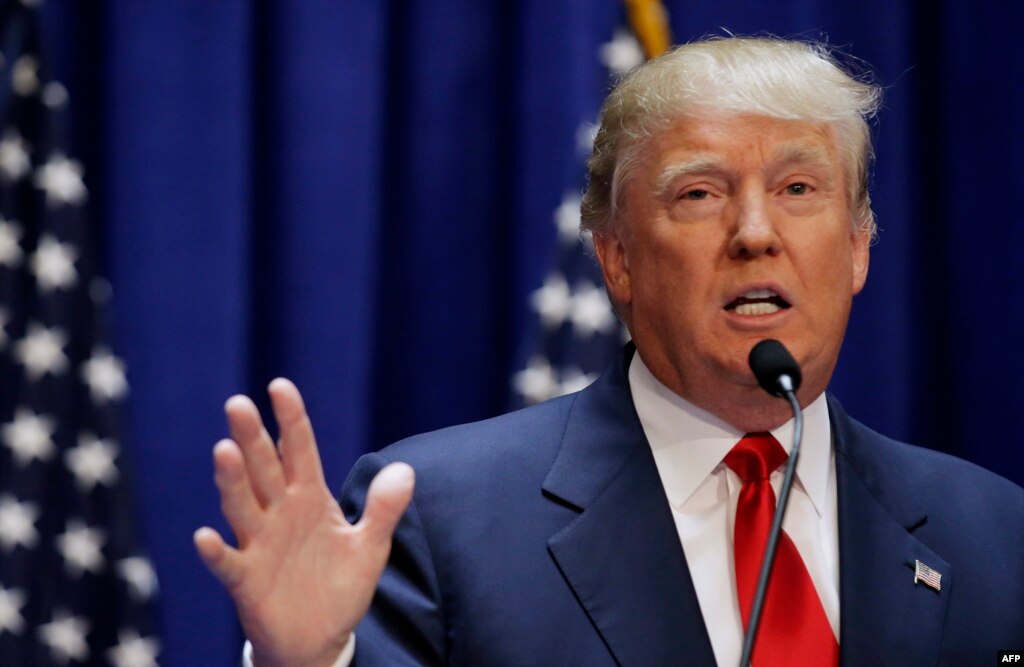
U.S. Republican presidential candidate, real estate mogul and TV personality Donald Trump formally announces his campaign for the 2016 Republican presidential nomination during an event at Trump Tower in New York, June 16, 2015.
Broadcasters, including NBC and Univision, dropped the pageant and a slew of celebrities lined up to perform, judge and host dropped out just as the pageant was kicking into high gear in Baton Rouge.

Pageant organizers rushed to fill the gap so the show could go on. Satellite and cable channel Reelz television stepped in to air the show, while assuring people that Trump would not benefit financially. It was also streamed live on the pageant's website. And former Miss USA and Miss Universe winners were recruited as judges.

Race relations
The pageant featured an evening wear and swimsuit competition as well as the question and answer session. The preliminary contest was held earlier this week and then the number of women remaining was progressively narrowed during the course of Sunday evening's telecast.

Jordan, of Tulsa, Oklahoma attended Boston University, where she earned a B.S. in Health Science and was a group fitness instructor and a personal trainer. She has appeared in several national and international commercials and feature films, most recently, Hot Tub Time Machine 2.

Paula Shugart, who heads the Miss Universe Organization, thanked the CEO of Reelz and the returning pageant winners for stepping in to help during a news conference Sunday.

"I love you all. You are the only reason we exist,'' she said to the women during a news conference Sunday.

Shugart said the challenges of the past few weeks will make for great practice for whichever woman is crowned Miss USA, teaching them how to stay focused: "You have to forget everything going on around you.''

When asked if the relationship between the pageant and Reelz would last beyond Sunday night, Stan Hubbard said the agreement was for one night only.

The 51 women represented every state and the District of Columbia.

Jordan will hold the title for a year and will go on to represent the United States in the Miss Universe pageant.

Blues Legend B.B. King Found to Have Died From Natural Causes

Friends and fans file past flowers and his famed guitar "Lucille," on their way to B.B. King's coffin during a public viewing, May 29, 2015 in the B.B. King Museum and Delta Interpretive Center in Indianola, Mississippi.
Veteran blues musician B.B. King died of natural causes primarily stemming from Alzheimer's disease, Nevada officials said Monday, putting to rest accusations by his two daughters that he was murdered.
King's death at age 89 in May was also attributed to coronary artery disease, diabetes, heart failure, high blood pressure and brain damage from low blood flow, the Clark County Coroner's office said in a press release.
Coroners said they determined King's cause of death after conducting an autopsy, toxicology tests and consulting a neuropathologist. The examination also concluded that while King had suffered strokes, they did not kill him.

Officials had said a homicide investigation would be conducted at the time of King's death after two of his children, Karen Williams and Patty King, alleged that the musician was poisoned by longtime associates. An attorney for King's estate said the allegations were unfounded.
"At this point we can say with confidence that Mr. King died of natural causes," John Fudenberg, the Clark County coroner, said.
"Our condolences go out to the family and many friends of Mr. King, and we hope this determination brings them some measure of closure."
King, a prolific and celebrated musician who was inducted into the Rock and Roll Hall of Fame, was placed in hospice care after being hospitalized in April this year from complications related to diabetes. He died shortly after, on May 14.
Hundreds of mourners gathered for his funeral in Memphis, Tennessee, bidding him a musical farewell.

Singer Neil Young Pulls Music From Streaming Sites


FILE - Neil Young performs at the Bridge School Benefit Concert at the Shoreline Amphitheatre in Mountain View, Calif., Oct. 20, 2012.
FILE - Neil Young performs at the Bridge School Benefit Concert at the Shoreline Amphitheatre in Mountain View, Calif., Oct. 20, 2012
Singer-songwriter and musician Neil Young said on Wednesday he won't allow his music to be streamed any more, not because of disputes over royalties, but rather over poor sound quality.
"I don't need my music to be devalued by the worst quality in the history of broadcasting or any other form of distribution," the Canadian rocker said in a post on his Facebook page.
"I don't feel right allowing this to be sold to my fans. It's bad for my music," he said.
Young, 69, was one of the biggest rock stars of the 1960s and 1970s with bands like Buffalo Springfield and Crosby, Stills, Nash and Young, and a successful solo career that has included albums like "Harvest" and "Rust Never Sleeps."
He has long complained about digital audio and, as a result, has developed Pono, a portable player that aims to lend a higher quality than streaming or MP3.
Criticizes streaming quality
Young said his decision is "not because of the money, although my share (like all other artists) was dramatically reduced by bad deals made without my consent."
His criticism is a new blow to streaming services like Spotify, the target of criticism from artists who complain of meager payments for their work.
Most notably, top-selling pop star Taylor Swift withdrew her catalogue from Spotify last November, saying the business had shrunk the number of paid album sales drastically.
Last month, Swift agreed to put her latest hit album "1989" on Apple Music, days after Apple Inc. did an about-face, agreeing to pay artists during a free trial of its new streaming music service.
Young also left the door open to returning to streaming. "When the quality is back, I'll give it another look. Never say never," he said.

Four Doctors Detained, Questioned for Illegally Operating Clinics

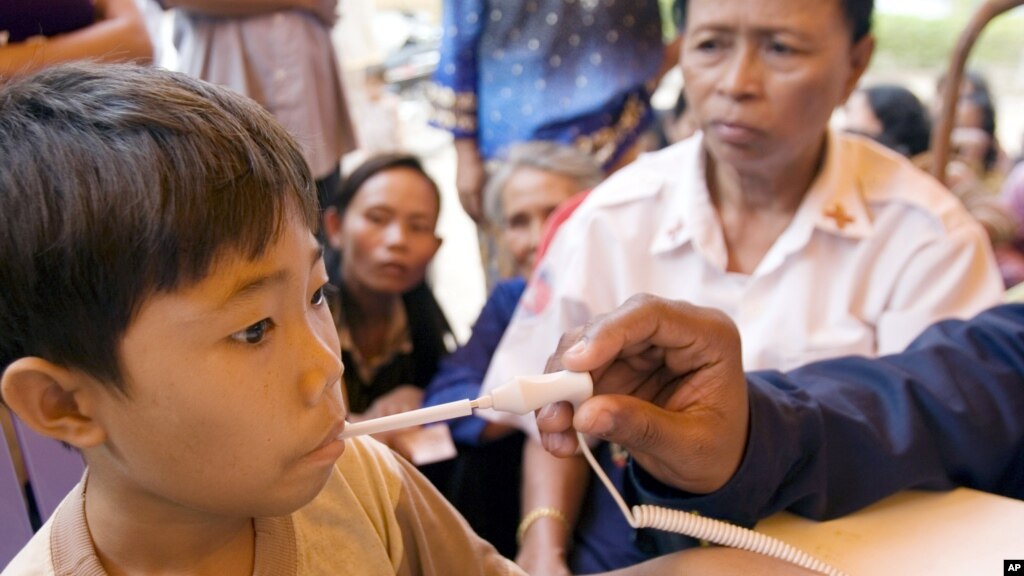
A U.S sailor gives a medical treatment to a Cambodian boy at a Buddhist pagoda, outside of Sihanoukville city, file photo.
A U.S sailor gives a medical treatment to a Cambodian boy at a Buddhist pagoda, outside of Sihanoukville city
Authorities in Battambang province are questioning four Chinese and Cambodian doctors who operated three separate medical clinics for years without a license.
All three clinics were closed in a crackdown on Tuesday.
Chet Vanny, Battambang’s deputy police chief, said the four are being held and questioned, and officials say they are looking into how they operated their clinics for up to 10 years without official permission.
The Cambodian doctors in question are Keo Sovann Sokyan, 63, and Vanthar Sieng Heng, 32. They ran a clinic called The Branch Association of Kind Cambodian Doctors.
The Chinese doctors are Ma Phy, 48, who ran a clinic called China-Korea 24 Hour, and Quo Liuana, 52, who ran the Khmer-China Friendship Clinic.
Battambang province was the site of a major HIV outbreak earlier this year, due to the reuse of infected needles by an unlicensed doctor—leading to sweeping crackdowns on similarly unlicensed clinics.

Hearings Scheduled for Doctors Allegedly Running Illegal Clinics

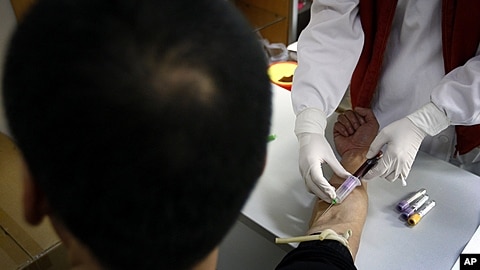
A man has a sample of blood taken by a nurse for HIV/AIDS testng, file photo.
A man has a sample of blood taken by a nurse for HIV/AIDS
Four doctors accused of running illegal clinics in Battambang province will appear in court next month.
The defendants, two Cambodians and two Chinese, will face fines, but no jail time, for allegedly running three clinics without a license.
The charges stem from a sweeping crackdown on illegal clinics in the province, after a massive HIV outbreak there was caused by an unlicensed doctor reusing infected needles on patients.
Noun San, prosecutor for Battambang provincial court, said the four doctors are not being charged with criminal acts. They have been released, but will face a hearing early next month. Their clinics, meanwhile, have been shut down.

Cambodia on Alert After MERS Found in Thailand

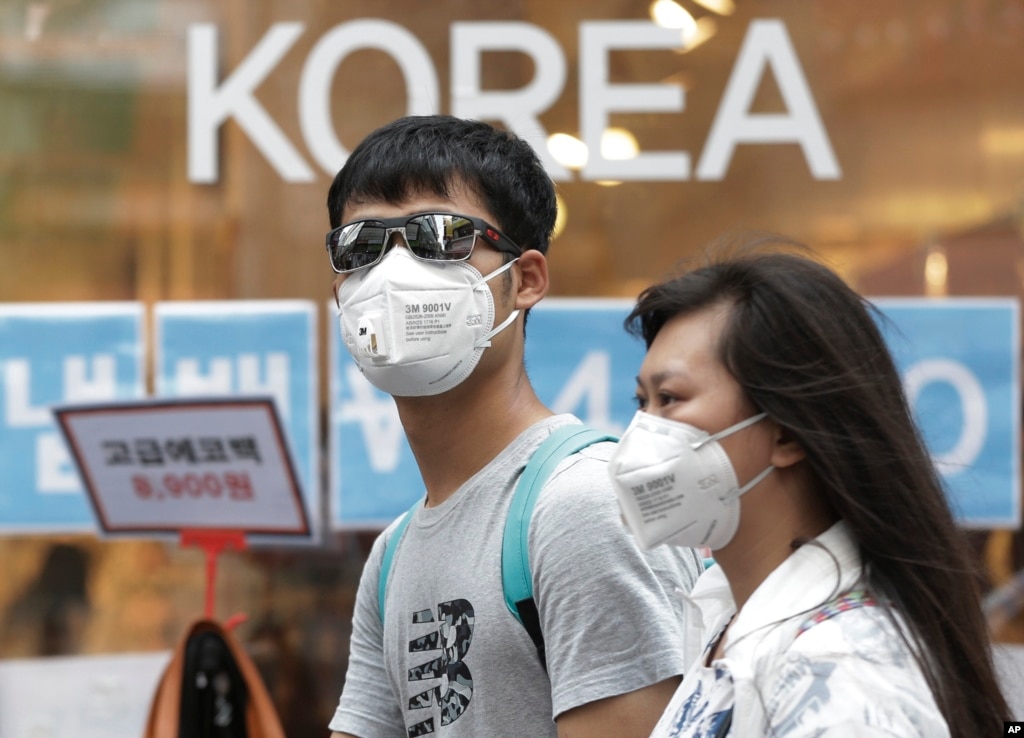
A couple wears masks as a precaution against the Middle East Respiratory Syndrome (MERS) virus as they walk in Myeongdong, one of Seoul's main shopping districts, June 15, 2015.
Cambodian health authorities are on high alert, following the first confirmed case of Middle East Respiratory Syndrome, or MERS, in Thailand, Thursday.
Diagnosis systems have been installed at major border checkpoints and at the airports of Phnom Penh and Siem Reap.
Health officials say people traveling in either the Middle East or South Korea should pay special attention to health symptoms and report any suspicious symptoms immediately.
Cambodia has no confirmed cases of the disease, Ly Sovann, deputy director for epidemiology at the Ministry of Health, told VOA Khmer. But the country has set up a special response team and is actively monitoring, he said.
“We have prepared everything, but it is very important that people who travel in the Middle East and South Korea stay on high alert and be careful,” he said. “They should report to us immediately if they suspect they have the disease.”
Cambodian Muslims visiting Saudi Arabia for the holy month of Ramadan should be especially careful, he said. They should avoid drinking camel’s milk and eating raw food.
MERS has killed a confirmed 24 people in South Korea alone, and has spread to 26 countries since 2012. Thai officials said Thursday that a 75-year-old businessman from Oman was diagnosed with the disease in Bangkok.

Campaign Begins for Improved Child Health

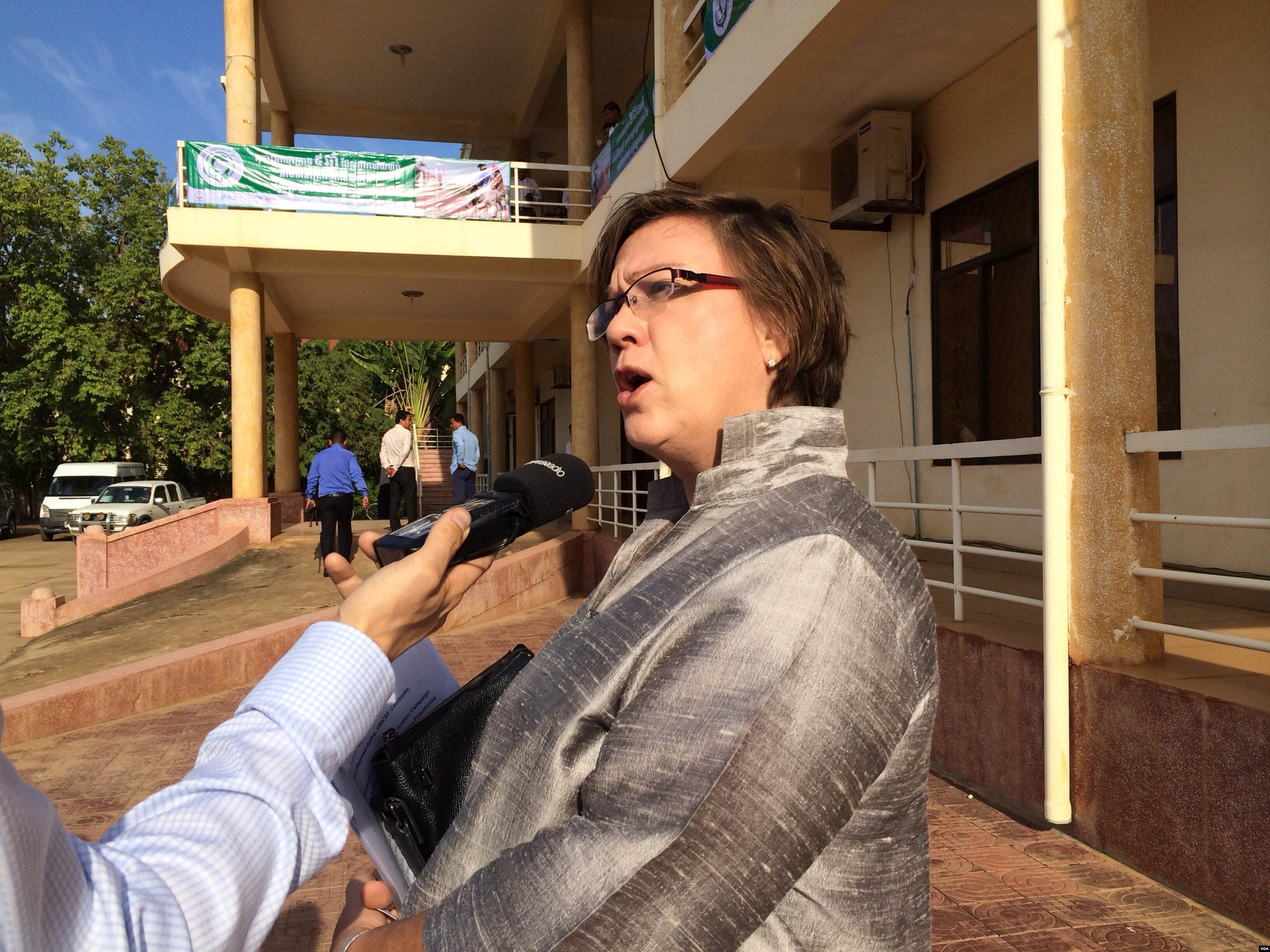
Health officials gathered in Kampong Speu province to educate Cambodians on how to fight child mortality.
Unicef and the Cambodian government have launched a campaign to promote better health for children and newborns. Cambodia has made some progress improving the health of women and children, but a high rate of death for children remains a major concern.
It saw its newborn mortality rate drop from 27 deaths per 1,000 live births to just 18.
Despite a great reduction in recent years, to 18 deaths per 1,000 live births, “there are still too many children who die too young, needlessly,” says Rana Flowers, a Unicef representative in Cambodia.
Some 200 health officials joined Unicef for the launch of a new initiative to improve that rate. The campaign will focus on Phnom Penh, as well as the provinces of Kampong Speu, Kampong Thom, Kratie, Stung Treng, Mondolkiri, Ratanakkiri and Preah Vihear—which have the highest rates of child mortality.
The campaign will include public service announcements to improve parents’ awareness of pneumonia and other illnesses.
Meas Bunly, a communication specialist for Unicef, said the campaign aims to improve survival rates by promoting the appropriate care for children. It will be aimed at mothers and caregivers, to help them understand childhood illnesses, help them prevent or treat them and encourage them to use health care centers and hospitals, especially when they recognize signs of pneumonia, like coughing and hard, rapid breathing.
  • Health officials gathered in Kampong Speu province to educate Cambodians on how to fight child mortality.
Pneumonia is a leading cause of death for children under five, and especially for children in the first month of life.
“Every day an estimated 35 children die before their fifth birthday as a result of preventable and treatable disease, such as pneumonia and diarrhea,” Flowers said.
In a Unicef survey last year, less than 15 percent of mothers and caregivers knew the signs, Meas Bunly said.
Only about 34 percent took children with signs of pneumonia to a public health facility. Only 3.6 percent took their children to a hospital after recognizing the symptoms. The campaign aims to increase that number to 25 percent in 2016.

Calls for More Regulation, as Hundreds More Workers Faint on Job

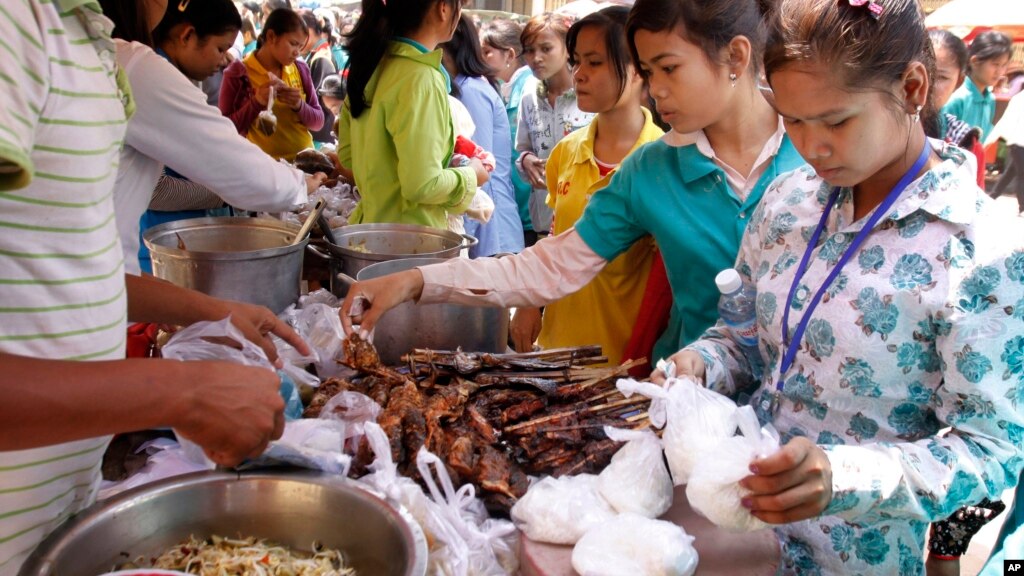
Cambodian garment workers buy some cheap food for their lunch in front of the factory in downtown of Phnom Penh, file photo.
Labor leaders are calling on the Cambodian government to do more to inspect factory conditions, with at least 300 workers fainting inside factories in the last four days.
A lack of wages leading to poor health, combined with stifling conditions inside factories, was likely to blame for the mass faintings, Ath Thun, head of the Cambodian Labor Confederation, told VOA Khmer.
Such faintings are preventable, he said. “First, the minimum wage must be increased for workers to have a decent living. Work hours must be reduced…. this will improve the health of workers. Second, companies must comply with standards for proper work times and environment.”
That means a work environment with safe levels of chemicals and proper ventilation, he said. “If any company violates the rules, it should be closed down. Once one or two companies are closed down, the rest will be afraid,” he said.
Chea Mony, head of the Free Trade Union, said the main issue remains the weak health of workers, who eat poorly and work too many hours. They can only afford street food, like cooked snails, pickled mango and dried fish, he said.
The International Labor Organization and international buyers all want better conditions, but many factories ignore these demands, due in part to corruption within state institutions, which “don’t enforce the law,” he said.
Heng Suor, a spokesman for the Ministry of Labor, could not be reached for comment.
Meanwhile, unions continue to call for a raise in the minimum wage, up to $177 per month, which they say is needed for workers to keep up with the rising cost of living in the country.

Opposition Leader Seeks Muslim Political Support

Opposition leader Sam Rainsy welcomed over a hundred Muslim Cambodians at his house in Phnom Penh to observe the end today's Ramandan fasting, July 5, 2015. (Ser Sayana/VOA Khmer)
Opposition leader Sam Rainsy met with Cambodian Muslim leaders recently, promising a broad range of political concessions important to their community.
Speaking to about 100 people at an Iftar dinner to break the Ramadan last Sunday, Sam Rainsy said he hoped to create a TV station, “Sun Television,” that will be inclusive of many Cambodians, including its Muslims.
“We will offer time to Khmer Islam, at least one hour a day, to broadcast religious and general affairs,” he said.
The Cambodia National Rescue Party was granted rights to a TV station in political negotiations last year, but it is still seeking funding for it. The opposition has long complained of a media environment that heavily favors the ruling Cambodian People’s Party.
Sam Rainsy made other political pledges to the leaders, saying an opposition-led government would allow more mosques and Islamic schools to be built, and would allow girls to dress in traditional manner.
“A new government would allow Khmer Muslim women to wear hijabs, in line with Muslim tradition, when they apply for official documents, including passports, identification cards and all types of job resumes,” he said.
He also said he would promote the construction of public prayer locations, including at universities, hospitals, hotels and markets. Muslim workers would have three-days during Ramadan, he said, and Cambodia would expand its embassies in Muslim countries.
Kem Ley, a political analyst, said few of the pledges are possible with the ruling Cambodian People’s Party in power. “Sometimes politicians don’t conduct a deep analysis on whether they can do what they say,” he said. “Mostly they make too many promises.”

Cambodian-American Artist Awarded for Work on Identity

The Sovereign Art Foundation has named Anida Yoeu Ali, a Cambodian American artist, winner of the prestigious Sovereign Asian Art Prize. 
Ali, an installation and performance artist, will accept the award, and the $30,000 prize that comes with it, on Friday. 
The foundation, created in 2003, is a charity organization that provides support for impoverished children through arts, “as rehabilitation, education and therapy.” It currently provides support in Cambodia, Vietnam, Mongolia, Nepal, and Sri Lanka. 
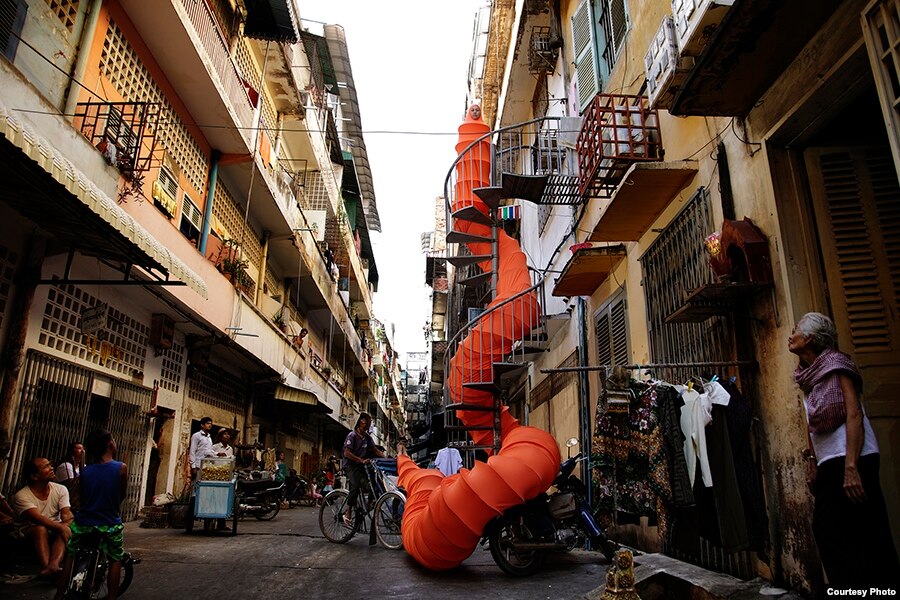
The winning artwork, Spiral Alley, is one of the series of photographic prints of a Cambodian American artist, Anida Yoeu Ali, who won the prestigious 11th Sovereign Asian Art Prize for 2015. (Photo: Studio Revolt)
The foundation said it had given Ali the award for works that “investigate the artistic, spiritual and political collisions of hybrid transnational identity.” Her work was chosen from 236 nominations from 13 countries in the Asia-Pacific, including Australia, Singapore, Pakistan, and Dubai. 
​Quoted in the foundation’s press release, Ali said she was surprised to win, but she hoped that in doing so she would “motivate and inspire other artists to keep pursuing contemporary art-making and performance art, no matter how difficult.” 
She added that although the Khmer Rouge had terminated almost all Cambodian artists, the spirit of art remains in the heart of every survivor, including herself. 
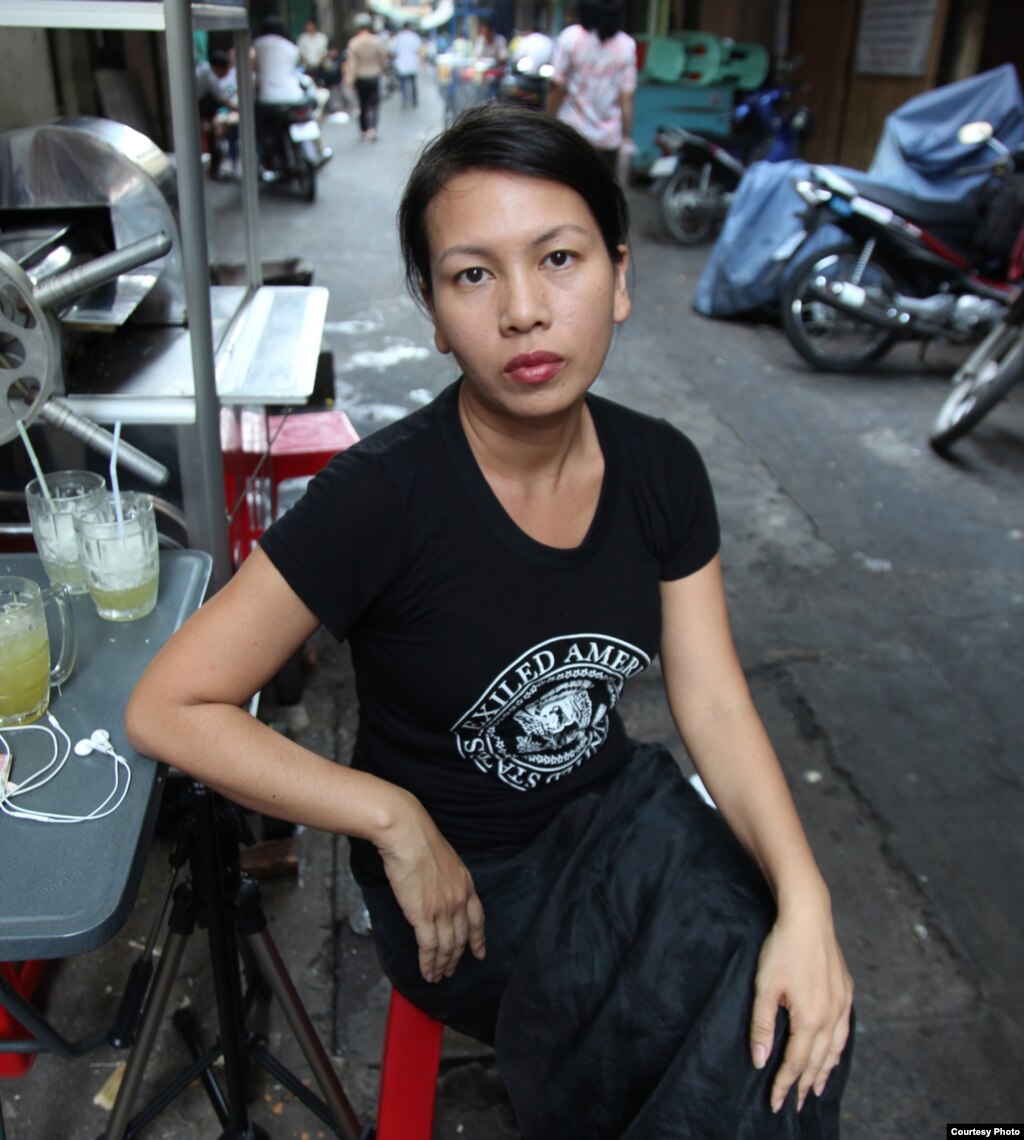
A Cambodian-American artist, Anida Yoeu Ali, who won the 11th Sovereign Asian Art Prize (Photo: Studio Revolt)
Ali is a Muslim-Khmer who escaped the Khmer Rouge to the United States. She is also co-founder of Studio Revolt, an independent artist-media lab in Phnom Penh. Not only does she produce video and images, but she also engages in performance and installation. 
“I am proud to be part of the return diaspora of Cambodians who are passionately rebuilding our legacy through art,” she said. 

Performance of ‘Hamlet’ Premieres in Phnom Penh Cambodia

Stage actors performing 'Hamlet' at the Royal University of Phnom Penh on Wednesday, July 8, 2015. (Photo: Oum Sonita/VOA Khmer)

Hundreds of Cambodians lined up outside the auditorium of the Royal University of Phnom Penh Wednesday night, awaiting the premiere of “Hamlet.”
William Shakespeare’s classic tragedy, in which Prince Hamlet of Denmark seeks revenge against a usurper uncle who has murdered his father and married his mother, remains a beautiful story, and one with wide appeal, the performance’s artistic director, Dominic Dromgoole, told VOA Khmer.
And even though the English play might be hard to fully understand, he said, “I hope that people will enjoy the story.”
The story begins with a tormented Hamlet, contemplating suicide, infamously asking, “to be, or not to be?” but determining instead to take revenge on a murder most foul, setting in motion a tragic chain of events. It ends in his death, his noble heart cracked by poison, and “the rest is silence.”
At least 1,000 people attended Wednesday’s performance, crowding into the hot theater hall and proving the timelessness and universality of the Bard’s storytelling.
Hundreds of Cambodian students attended the first performance of Shakespeare's 'Hamlet' at the Royal University of Phnom Penh, Cambodia.
Seng Virakbuth, a freshman at the Institute of Foreign Languages, said the performance “opened my eyes.” He was impressed by the performers, he said, who took on various roles during the play.
Cheam Kokhor, a sophomore from the institute, took away something more. “Revenge is nothing, in the end,” he said. “It only causes us trouble and wastes our time. However, understanding and forgiveness are the priceless things that we need to have in society.

An Irresistible Force Meets an Immovable Object

china-hk-reform-reject-june-2015-ii.jpg
Hong Kong pro-democracy supporters stand outside the city's legislature after a vote in Hong Kong, June 18, 2015.

On Aug. 31 last year, the standing committee of the National People's Congress (NPC) made a preemptive decision about how the people of Hong Kong should run Hong Kong.

Yesterday, the Legislative Council (LegCo) met, quorate, with 36 people present. Twenty-eight votes were cast against the plan, while eight were for it, overturning the decision of the NPC standing committee.

This session was conducted according to law, so it naturally has an incontrovertible legal effect. While the decision of the NPC standing committee was once legal, now it has been overturned in LegCo by 28 votes to eight, which gives it legal effect.

The decision of the NPC standing committee isn't worth the paper it is written on now.

This is the first time the [ruling] Chinese Communist Party has met with such a setback within its own borders since it seized power in 1949.

The Aug. 31 decision of the NPC standing committee was concerned with elections. It said that it would expand the voting franchise for elections for the chief executive in Hong Kong to "one person, one vote."

That should be a good thing, but it also set down that nominations for candidacy must fit in with the wishes of the central government.

So it was effectively saying that Hong Kong people could have the right to vote, but not to nominate; that they could only hold free elections with one person, one vote within the framework it was laying down.

Let's say that candidates surnamed Wang, Zhang, Jiang, Yao, Kang and Mao were inside this framework, then the voters of Hong Kong could choose one that seemed suitable from among them to be chief executive. But they wouldn't be able to vote for Peng, Gao or Xi*, let alone anyone surnamed Zhang, Luo or Chu.

This is democracy with Chinese characteristics taken to a very high pitch. It is on a much higher level than the preselected "elections" that have been running throughout the 60-year history of the People's Republic.

To use an old Beijing saying, it's a crafty switch in tactics. But it's more suited to the Middle Ages than to the 21st century.

And just because this is found acceptable in mainland China, it doesn't mean there's a market for it in Hong Kong.

A 'heavy' crash

This elite, which has grown used to being the only show in town, and to having its own way for several lifetimes now, has suddenly run slap-bang into an obstacle that is hard to get past, and the crash has been a heavy one.

What's more, it has done so after putting many years' worth of effort into this task, under the watchful eyes of the Chinese people.

For the people of Hong Kong, rejecting fake universal suffrage isn't the same thing as getting genuine universal suffrage.

They have won a battle, but not the war. There is still a long and hard road to travel, that leads towards Hong Kong people ruling Hong Kong.

Everything depends on Hong Kong people redoubling their efforts and not giving up along the way.

From the point of view of the Aug. 31 decision, maybe this isn't such a bad outcome after all.

It's probably a good one. It's a bitter pill to swallow, but also a wake-up call.

So far, we have only had some rather mocking reactions [to the vote] from a few bit players. The key characters have refrained from knee-jerk reactions, knowing better than to jeopardize their status and future by association with something that has been rejected, and will be consigned to the trash heap of history.

I hope that we can move on from this with a lesson from party elder Xi Zhongxun [father of Chinese president Xi Jinping], who believed that different opinions should be respected, protected and treated with courtesy, and by studying the broad direction of public opinion, which is akin to Modern Democracy 101.

Doing this will bring prosperity to the people of Hong Kong, mainland China and Taiwan, and definitely to the Chinese Communist Party, and will make everybody truly happy.

*Editor's note: In the summer of 1962, Mao Zedong announced at Beidaihe that there was an anti-party clique in the Chinese Communist Party comprising Peng Dehuai, Gao Gang and Xi Zhongxun.

Translated by Luisetta Mudie.


Bao Tong, former political aide to the late ousted premier Zhao Ziyang, is currently under house arrest at his home in Beijing.

China Emissions Spark Climate Debate

china-coal-emissions-jilin-jan-2014.jpg
Smoke is discharged from chimneys at a coal-fired power plant in Jilin city, Jan. 8, 2014.

Experts are at odds over China's efforts to curb greenhouse gas emissions, clouding forecasts for combatingclimate change.

On June 8, analysts at the London School of Economics (LSE) raised hopes for avoiding the worst consequences of global warming in a paper predicting that China will reach a peak in carbon dioxide (CO2) emissions well before the 2030 target set by President Xi Jinping last year.

China's emissions "are much more likely to peak by 2025. They could peak even earlier than that," said policy analyst Fergus Green and Nicholas Stern, a former World Bank chief economist, at LSE's Grantham Research Institute on Climate Change and the Environment.

Key factors cited for the improved outlook include the government's "new normal" economic policies of accepting more moderate growth rates and a 2.9-percent drop in coal consumption in 2014, according to official data.

Greenpeace/Energydesk China recently estimated that coal use also fell nearly 8 percent in the first four months ofthis year from the year-earlier period, based on production reports by the National Bureau of Statistics (NBS).

The decline in coal burning through April has cut CO2 emissions by 5 percent from a year before, Greenpeace said.

An early peak of emissions in China could prove crucial to keeping the growth in global temperatures below 2 degrees Centigrade (3.6 degrees Fahrenheit), the limit set by the United Nations Intergovernmental Panel on Climate Change (IPCC) for averting drastic warming effects such as a major rise in sea levels.

The study foresees the possibility that China could rapidly reduce greenhouse gas (GHG) emissions after the peakis reached in 2020-2025 by implementing a series of structural policies and reforms.

Early peaking could "hold open the possibility" that the world would stay within the 2-degree goal, the authors said.
Preparation for Paris

In order to keep the possibility open, China would have to cut some 15-20 percent of its emissions by 2030 with measures including more efficient urbanization, further coal reductions, new technologies, tax changes and pricingreforms.

The study is one of many that can be expected in preparation for an international climate conference in Paris in December, when national pledges for GHG limits are expected to be specified.

But the LSE outlook for China appears to be far more optimistic than a key forecast offered one week later by theParis-based International Energy Agency (IEA) in a preview of
its annual World Energy Outlook, focusing on climate change.

"Given the pace at which China's energy sector emissions have grown, achieving a peak in emissions by 2030 willrequire a significant change in direction," the IEA said.

For years, China argued that its role as the world's leading emitter of energy-related CO2 should be balanced byits far lower per-capita emissions compared with the United States and past pollution by the industrialized West.

But China's per capita emissions have already matched those of the European Union, while its total was about one- third higher than U.S. emissions last year, according to IEA estimates.

By 2030, China's emissions will be two-and-a-half times more than those of the United States, based on current"intended nationally determined contributions" (INDCs) to the climate change effort, the IEA said.

Last November during President Xi's visit to Washington, President Barack Obama pledged to lower U.S. emissions 26-28 percent from 2005 levels by 2025, which the study said would amount to the largest reduction in the world.

In a joint commitment hailed as "unprecedented," Xi announced China's goal of peaking CO2 emissions "around2030," or possibly earlier, and increasing the non-fossil fuel share of energy use to 20 percent.

At last week's Strategic and Economic Dialogue meeting in Washington, special climate change representative Xie Zhenhua suggested China could go further with its INDC commitment.
Planned measures would require investments of 41 trillion yuan (U.S. $6.72 trillion), Xie said.
Stronger action urged
On Monday, state-run China Daily said an announcement was expected during Premier Li Keqiang's visit to Europe this week.

Based on INDC pledges indicated at the time of its study, the IEA sees no peak in world CO2 emissions by 2030 and no chance of keeping within the 2-degree bounds.

"If stronger action is not forthcoming, the INDC scenario is judged to be consistent with a global temperature increase of around 2.6 degrees Centigrade in 2100 and 3.5 degrees after 2200," it said.

One reason for the differing forecasts is the split over the pace of progress in China, which would account for 29percent of global emissions in 2030 compared with 11.5 percent for the United States.

The IEA sees China's peak emissions as coming later and lasting longer than the LSE study predicts.

"Effective policy intervention across a range of sectors will also be required if the steep emissions growth observedin recent decades is to be succeeded by a similarly sharp slowdown in the years to come," the agency said.

Despite China's new environmental law, stricter enforcement and greater efficiency, the country continues to burn more coal than the rest of the world combined.

Unfortunately for the planet, the effects of GHG emissions are cumulative, putting all nations on smaller "budgets" for future releases in order to meet the 2-degree goal.

David Fridley, staff scientist at the China Energy Group of the U.S. Department of Energy (DOE) Lawrence Berkeley National Laboratory, said the LSE forecast appears to be "overly dependent on 2014 being a pivot year for coal consumption."

"In my experience, one year of data is simply insufficient to extrapolate from, particularly in China, where the datathemselves are of questionable reliability," Fridley said in an email message to RFA.

In 2014, coal consumption fell for the first time in 14 years to 3.51 billion metric tons, according to National Bureau of Statistics (NBS) data, lifting hopes that CO2 emissions could soon follow suit.
Doubts overshadow forecast
But several doubts overshadow the forecast.

One major concern is that China's coal reports are notoriously questionable. A Stanford University study from2011, based on provincial totals, found that coal data may be understated by as much as 500 million tons per year.

Some of the reported decline may also be due to non- recurring conditions.

A big jump in hydropower generation last year, variously estimated at 18-22 percent, helped to keep coal-fired power production down. Hydropower output has risen over 50 percent since 2011, thanks largely to a series of unusually wet years.

Rock-bottom coal prices and huge overcapacity of China's coal-fired power plants may also continue to dampen emissions reductions without stringent new policies and preventative steps.

This year, coal prices have dropped by over 20 percent from already-low levels in 2014, making it more costly forindustry and power producers to replace with cleaner fuels.

Utilization rates at thermal power plants fell to a record low of 53.7 percent last year, according to Reuters, creatingincentives for coal burning that could be hard to overcome.

Since coal-fired power accounts for 38 percent of China's coal consumption and a similar share of CO2, closures may be crucial to achieving emission goals.

The IEA projects that 95 percent of existing coal-fired power capacity will still be operating in 2030 under currentINDC plans, establishing a base of emissions that will be hard to drive down.

Even if coal use can be controlled, China's emissions may continue to grow.

"CO2 won't peak when coal peaks, since there's not a commensurate peak in oil and natural gas demand growth,"Fridley said. It may be five years or more before emissions cease to increase.

Perhaps most important, both the optimistic and more pessimistic forecasts presume that China's government willcontinue to resist a return to the highly-polluting economic stimulus policies that staved off recession in 2008-09.

The recent push for more local infrastructure projects and "targeted" stimulus spending have raised concerns thatlonger-term environmental goals may again take a back seat.

DOE researchers foresee a longer plateau of coal use at a high level, "in part because we also see a plateau of adecade or so for heavy industrial output after those volumes peak, as well," said Fridley.

The result "can easily push the CO2 peak out to the 2030s," he said.

In light of the risks, the IEA study urges more ambitious INDC pledges and a "bridging strategy" to achieve peakemissions by 2020 with a series of measures, including increasing energy efficiency and banning construction ofinefficient coal-fired power plants.